REMINISCENCES by Strahil Petrovski
Tuesday, December 30th from 6 to 9 pm: Reception for Artist in Residence Strahil Petrovski
“If the doors of perception were cleansed, every thing would appear to man as it is, Infinite.”
William Blake
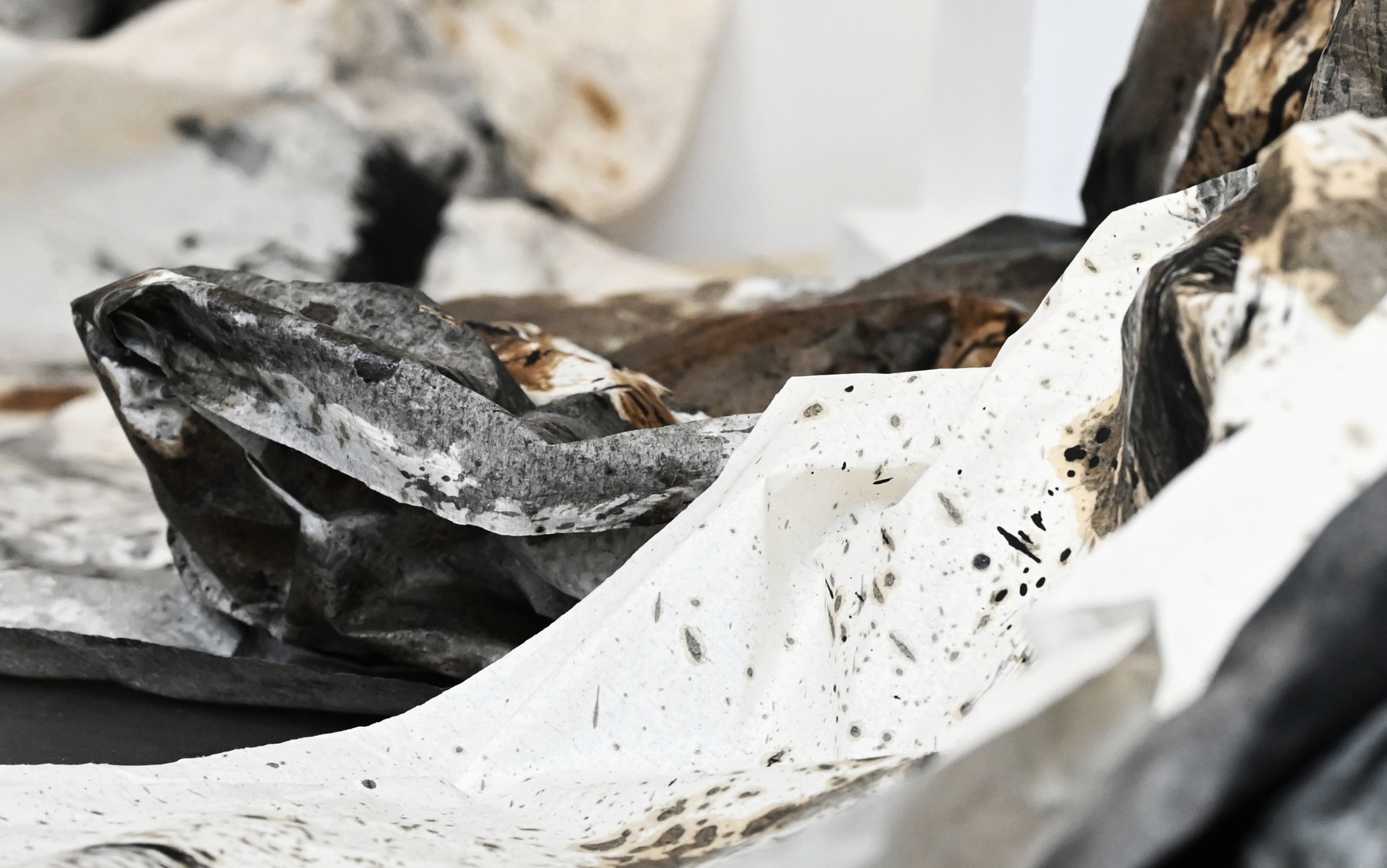
Reminiscences marks the latest era in Strahil Petrovski’s creative artwork: the era of large industrial paper (530×83см) and drawings of smaller dimensions made with mixed media techniques that once again find a new and deeper meaning in each new space. Three colors, colors that are actually not colors at all, but that were mostly used in ancient mosaics, embellish the industrial paper and the small-size drawings. Through the purity of the white color, the red bricks that stand for dried blood, rust and earth and the darkest black color, they embark together on a new journey with the color of light, the color of earth and the color of the void. When we see, when we really see/perceive or “listen to” Strahil’s works of art, they sing industrial and/or progressive rock. The melody of light and darkness, which is expressed through the transcendental sounds of music bands like Tool, Nine Inch Nails and Joy Division, reveals the reflection of the contemporary world entrenched in the struggles for identity and meaning. It is in the abstract forms that any person seeks recognition – a figure, himself/herself and/or something similar to him/her… Through the fragmentation, which is a quest or a new beginning in itself, a deconstruction or a game of chance, Strahil’s works of art are primarily a result of skill and innovation. Theodor Adorno believed that writing poetry about the Holocaust was barbarian and that there was no room in this world for such new beginnings. Petrovski’s art, which is a color that serves a poetic, elusive – or almost elusive – abstract and installation purpose, emanates a spirit of conflict with the possibility of a meaning in the world after unimaginable horrors. After the horrors, the world emerges as the only possible world that we have managed to create and keep. We continue writing poetry and we continue painting. In the new worlds, in the world without stable identities, in the world of ephemeral identities, where is the thing that we are looking for and where do we find a meaning, if we manage to find it all?
Strahil Petrovski’s works of art – the industrial paper and the drawings, as well as the video installations (in some of his former visual representations) – show their awareness of this lostness, which is why he (the artist) seeks a new unity in fragmentation, if this is possible at all following the devastating fracture of the 20th century. Through his multidisciplinary creations, Petrovski expresses this fragmentation of reality. In these new worlds of ours, we lack the “common” meaning. In the video installations for some of his previous exhibitions, in which he used images of war, worms, burned trees and desolate places with blankets that are being used by homeless people, lost and forgotten people are parading. These fragments of the urban dystopia are the perfect companions to the pieces of paper and Petrovski’s artwork made with combined techniques, thus disclosing the unpreparedness of the modern man to deal with the present-day and eternal problems.
The dimensions of the paper artworks express a subconscious (or perhaps not so subconscious) search for the sublime. The unfamiliar meaning and the disorientated fragmentation, as well as the limited human knowledge/perception, are the subjects that have been bothering mankind since the beginning of the refinement of their perception. The absence of answers and the cruelness of evil and horror, as well as the existential, military and excessively materialistic issues, bother not only those who turn into subjects in this planetary drama of cosmic proportions when it comes to the human tendency to destroy the others if they are a religious or territorial enemy. Strahil Petrovski’s perception trails radiate doubt that we can actually distance ourselves from our individual and collective bubbles. Our ability to stand up for the others and to understand them has indeed been put to the test. The narrative that accompanies Strahil’s creations keeps repeating: We are moving forward, we are going backward… Our future is at stake… Thinking is illegal… The endless story of the collective chaos continues with: “Do we dare look at ourselves in the mirror?” and concludes with: “We are brave enough not to go anywhere.” What would they see in the distorted selfie mirror? Our doors of perception have been distorted or blurred not because of the use of mescaline, as was (or was not) the case in Huxley’s autobiography entitled “The Doors of Perception”, but because of the overall confusion of our uneducated world in media terms. Strahil Petrovski’s opus entwines the conscience and the concerns over this drawback within the awareness of our own limitations. In his works of art, we are all exposed under the spotlight that reveals all of our inconsistencies and shows us through its brilliant simplicity and the esthetic sublimity of the monumental that the need for a rebellion, like the rebellious Atlas, is not a feature bestowed only upon deities. In the tragic spirit of every good myth, it is within us, mortals, too. Strahil Petrovski’s creations observe our corruption-imbued societies and directly, without any sugarcoating, demystify each and every one of their dysfunctional aspects.
Sandra Despotovikj
Curator and art historian